News & Events
.jpeg)
2026-07-13: Honorable Commerce Minister and Sylhet City Corporation Administrator Visit IWM
Mr. Khandakar Abdul Muktadir, Honorable Minister for Commerce, Industries, and Textiles & Jute, accompanied by Mr. Abdul Quiyum Choudhury, the Administrator of Sylhet City Corporation, visited IWM on Saturday, 6 June 2026. Md. Amirul Islam, Executive Director of IWM, warmly welcomed the Honorable Minister with a flower bucket. The visit underscored the growing recognition of IWM's technical expertise among policymakers and local government leadership and offered an important platform for dialogue between the Institute and the visiting dignitaries on pressing water and climate challenges facing Bangladesh's North-East Region.
The visit commenced with an executive briefing by the Executive Director of IWM, who presented an overarching overview of the Institute's strategic vision, institutional mandates, and technological innovations. The briefing traced IWM's evolution as a national center of excellence in water resources modelling, its integration of advanced hydrodynamic and GIS-based tools into planning processes, and its expanding portfolio of work in climate adaptation, coastal resilience, and urban water management.
More Details.jpeg)
2026-06-07: PHWI Delegation from NED University, Pakistan Visited IWM
IWM hosted a delegation from the Panjwani-Hisaar Water Institute (PHWI), NED University of Engineering and Technology, Karachi, Pakistan, from 7 to 11 June 2026. The delegation was led by Ms. Simi Sadaf Kamal, Advisor; accompanied by Mr. Haris Akram Bhatti, Assistant Professor (Operations); and Ms. Kausar Hasmi, Manager (Planning & Development) from the PHWI, NED University, Karachi, Pakistan. The delegation was warmly received by Md. Amirul Islam, Executive Director of IWM, who extended a cordial welcome with floral greetings on behalf of the Institute.
The visit constituted a continuation of the institutional dialogue initiated at the 7th Karachi International Water Conference and was undertaken with the principal objective of strengthening trans-boundary academic and technical collaboration in the fields of water security, sustainable water resources management, and climate-resilient water research. It further sought to operationalise a proposed multi-year joint research programme among PHWI, the Institute of Water and Flood Management (IWFM) of Bangladesh University of Engineering and Technology (BUET), and IWM, with generous travel support extended by OIC-COMSTECH, the Standing Committee on Scientific and Technological Cooperation of the Organization of Islamic Cooperation.
More Details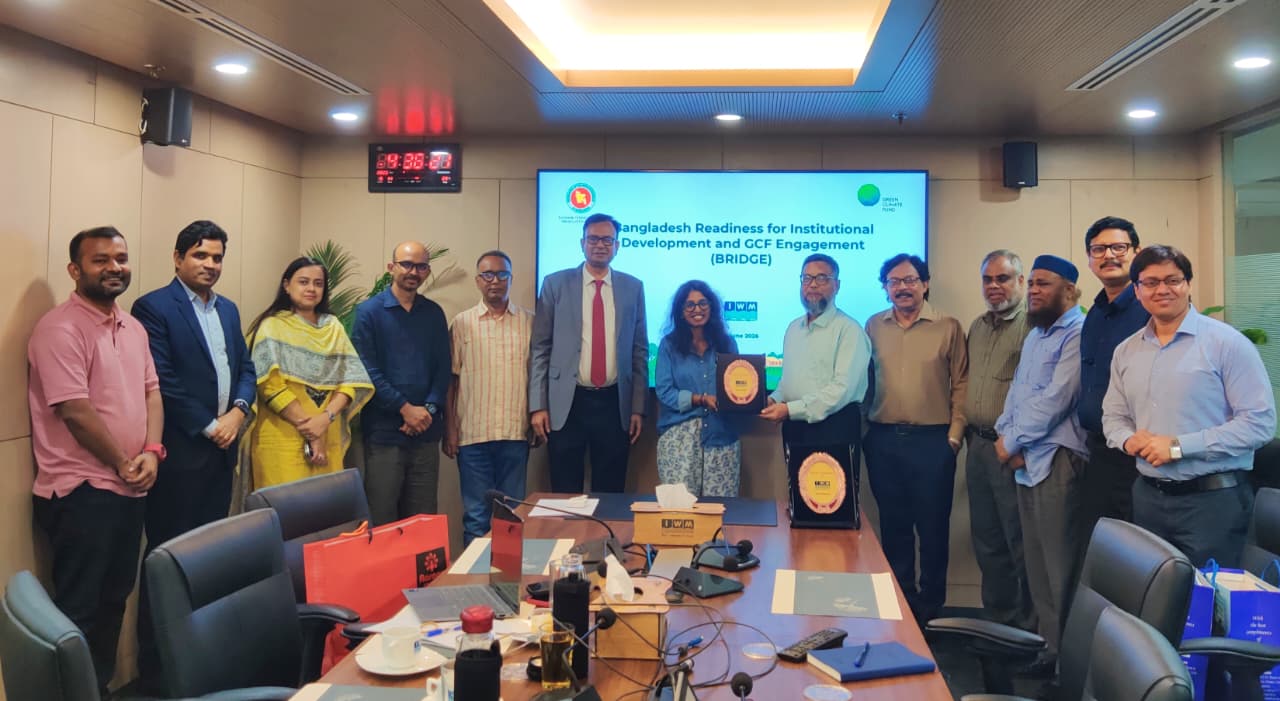
2026-06-11: GCF Delegation & ERD High Official Conducted a Visit to IWM
IWM hosted a delegation from the Green Climate Fund (GCF) on Thursday, 11 June 2026. The GCF delegation was led by Ms. Diane Jegam, Regional Manager, East and South Asia, and accompanied by Dr. Bapon Fakhruddin, Senior Specialist for Water Resources Management. Md. Amirul Islam, Executive Director of IWM warmly welcomed the GCF team. The visit underscored IWM's growing role as a key institutional partner in advancing climate finance and climate action in Bangladesh.
More Details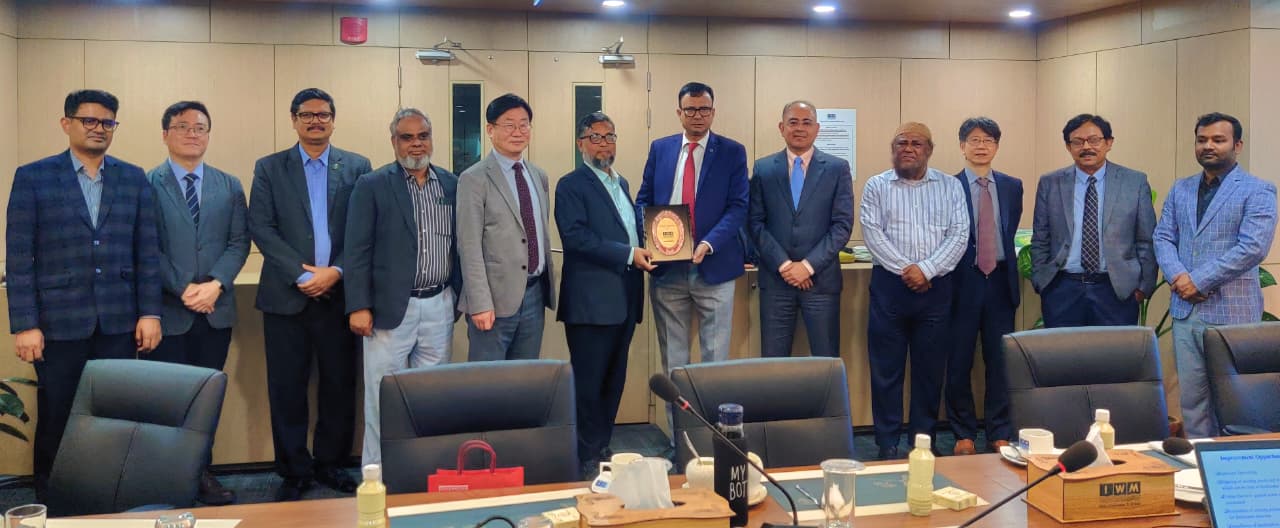
2026-01-20: KEITI and Korean HydroCore Delegates Visited IWM
The Institute of Water Modelling (IWM) hosted a distinguished high-level delegation from the Korea Environmental Industry & Technology Institute (KEITI), under the Ministry of Climate, Energy and Environment of the Republic of Korea, along with senior representatives from the Economic Relations Division (ERD) of the Ministry of Finance, Government of Bangladesh, on 15 January 2026.
The delegation was warmly welcomed by Md. Amirul Islam, Executive Director of IWM. The ERD delegation was led by Mr. A. K. M. Sohel, Additional Secretary and Wing Chief (UN Affairs), accompanied by Ms. Shakera Ahmed, Deputy Secretary, UN-2 Section, and Mr. Md. Juel Mahmud, Green Climate Fund (GCF) Liaison Officer of Bangladesh. The Korean delegation consisted of Mr. Nam Jaehyun, Senior Research Specialist at KEITI; Dr. Bhon K. Koo, Chief Executive Officer of HydroCore; Mr. John Song, Director of HydroCore; and Mr. Rahul Teku Vaswani, Consultant on Climate Change and Sustainability.
The visit marked an important milestone in strengthening international collaboration on climate-resilient development. Discussions focused on Bangladesh’s strategic opportunities under the Green Climate Fund (GCF) Readiness Programme and explored innovative, scalable solutions to address the country’s growing climate challenges. IWM showcased its pioneering work in carbon credit development and nature-based solutions, demonstrating how climate mitigation efforts can be effectively integrated with livelihood improvement and ecosystem restoration.
More Details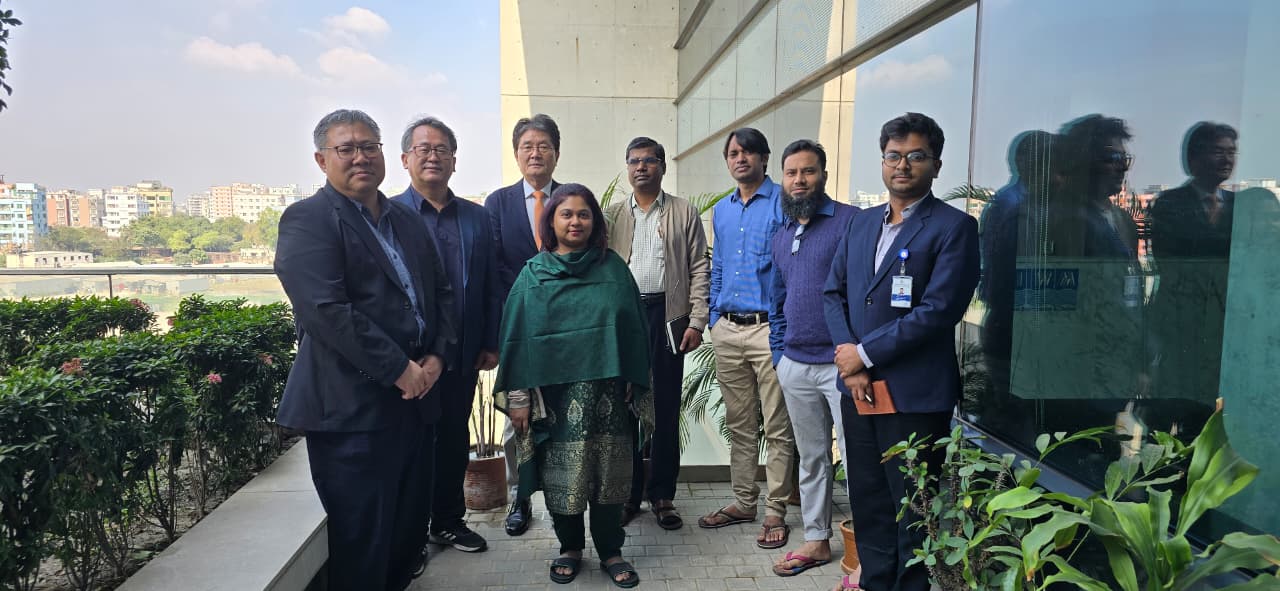
2025-12-21: Korean Delegates Visits IWM to Discuss Urban Flood Forecasting Initiatives in Bangladesh
A delegation from the Republic of Korea, led by Dr. Kyung Taek Yum, Vice Chairman of Korea Engineering Consultants Corporation, paid a visit to the IWM on 17 December 2025 to discuss urban flood forecasting and flood risk reduction initiatives in the Dhaka Metropolitan Area, with particular emphasis on the Buriganga River corridor. The delegation was welcomed by Dr. Mollah Md. Awlad Hossain, Deputy Executive Director (Planning & Development) and Mr. Tarun Kanti Magumdar, Director, Flood and River Basin Management (FRM) Division, along with senior officials of IWM.
More Details